Gravity L1 Mainnet: Beginning the Transition
\\\\\\
Company
Author
Gravity
Gravity Alpha Mainnet launched in August 2024 to bring Galxe onchain. Since then it has processed hundreds of millions of transactions under real production load, ranking among the fastest chains by block time. Alpha Mainnet was always meant to be a proving ground, a live environment that would surface the real bottlenecks as we built toward an L1. Almost two years of running that network shaped how we designed Gravity L1, from Grevm (Gravity's parallel EVM) to the Gravity SDK and our contributions back to Reth. Today marks the next step in that journey, the transition from Alpha Mainnet onto Gravity's own L1.
Gravity L1 is starting in permissioned mode by design. Only a small set of invited validators are operating the network for now, and Galxe is the first application moving over from Alpha Mainnet. Running Galxe on Gravity L1 is how we validate the network under live traffic before opening the doors wider. G is Gravity's native gas and staking token. Over time we'll bring more validators online, invite more applications to migrate or build directly, and gradually move to a fully permissionless public network.
The World Computer for the Agent Era
If Alpha Mainnet proved the foundation, Gravity L1 begins a larger story. Gravity L1 brings high-performance EVM execution, a native oracle, and a native random number generator into the same environment. Contracts access trusted offchain state and protocol-level randomness directly, without fragmenting core logic across external oracles, bridges, or extra infrastructure.
As agents begin to represent users across more parts of daily life, from search and trading to payments, coordination, content creation, and social interaction, they need more than a wallet or an account. They need a backend that can read and write state, execute rules, settle value, and stay synchronized with the external world. Gravity is that backend, a world computer for AI-native applications.
To offer an early glimpse of this direction, we're releasing Gravity Town, a fun public experiment that explores some of the ideas behind it. In Gravity Town, agents aren't merely offchain scripts or characters inside a chat interface. They inhabit a small world directly onchain, owning assets, taking actions, responding to environmental changes, interacting with other agents, and using smart contracts to persist rules and state. The world isn't simulated by a server, it's driven by onchain state and made verifiable by the protocol itself. This is the key difference between Gravity L1 and traditional high-performance chains. Most are built to make humans click and confirm faster. Gravity is built for the agents acting on users' behalf. As agents become the new interface of the internet, Gravity aims to become the execution layer behind them.
What This Means For Alpha Mainnet
If you're active on Alpha Mainnet, this transition doesn't require any immediate action. Over the coming months Alpha Mainnet will be sunset, and users who want to continue on Gravity L1 will need to bridge their assets across.
What's Live Today
Gravity L1 is a fully EVM-equivalent Layer 1 with sub-second finality and 12,000+ transactions per second on modest validator hardware (8 vCPU / 16 GB RAM per node). Every layer of the stack is built for high throughput.
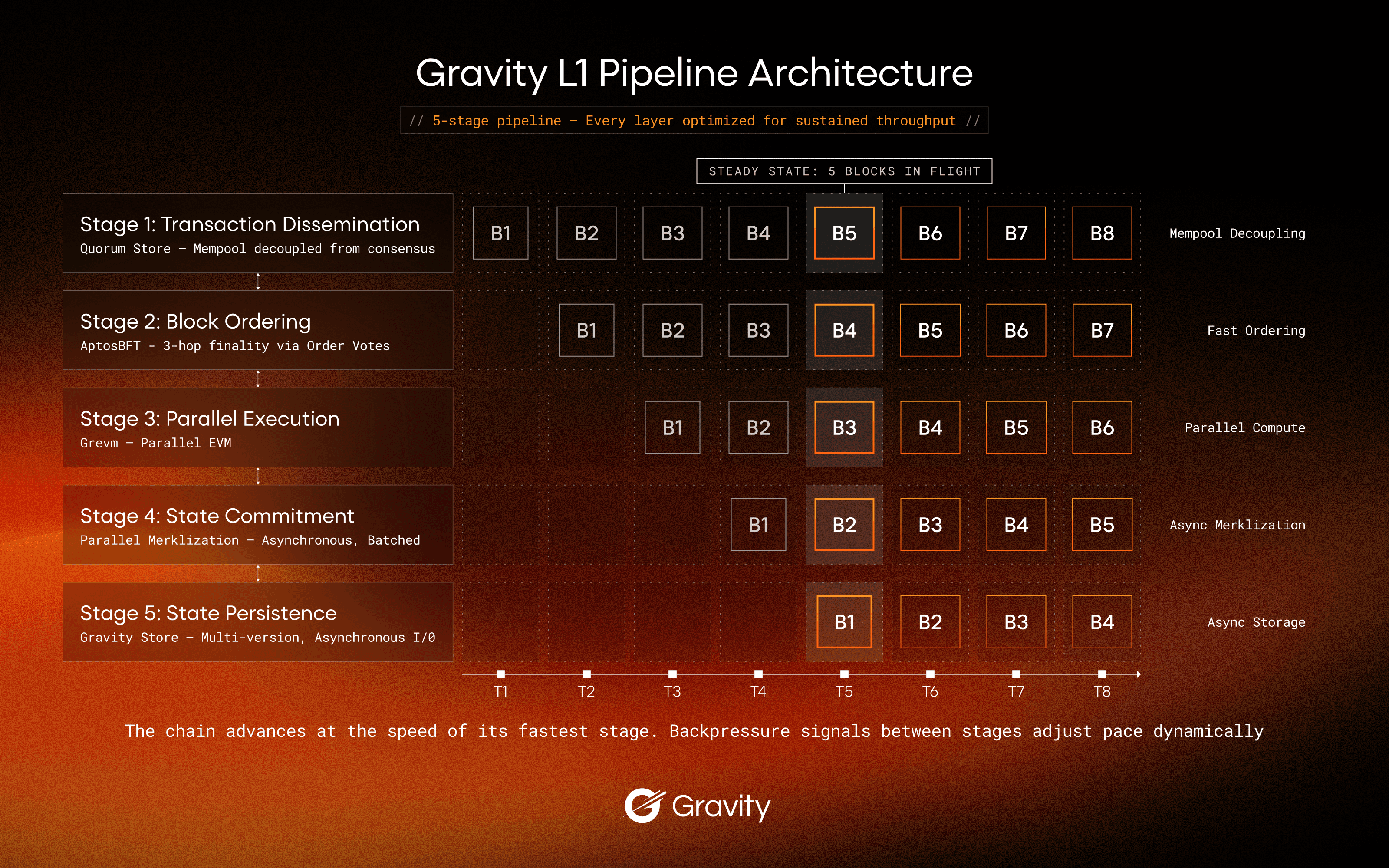
Pipelining: 5 stages running concurrently across blocks.
Mempool: Quorum Store streams batches in parallel, no leader bottleneck.
Consensus: AptosBFT with 3-hop finality, the theoretical lower bound for BFT.
Execution: Gravity Reth (our fork of Paradigm's Reth) powered by Grevm, a parallel EVM.
Storage: Parallel merklization, multi-version Gravity Store, async I/O.
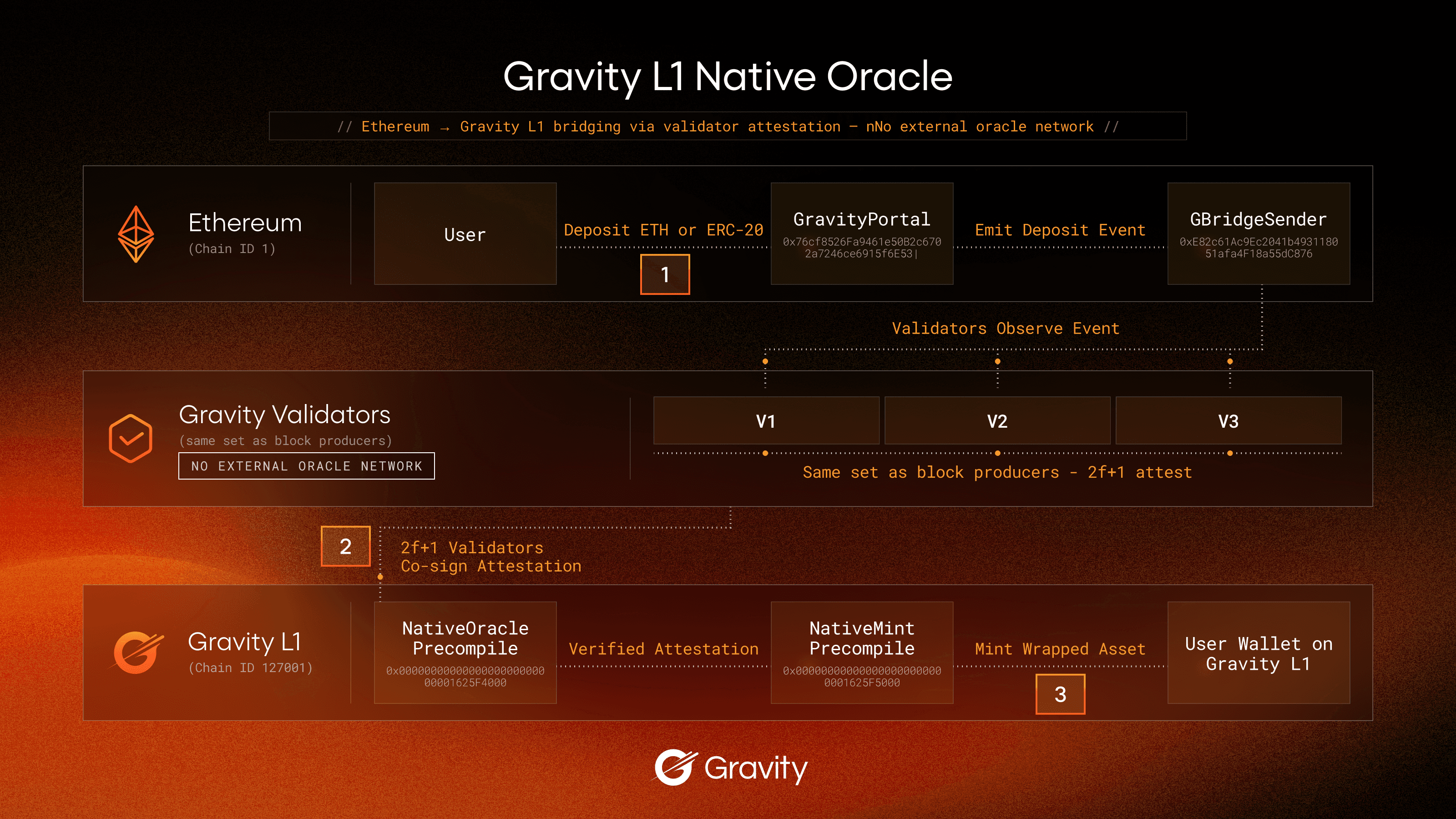
Native oracle: validator-attested cross-chain primitive, same finality as native transactions.
Several optimizations have been merged upstream into Reth; we're collaborating with Paradigm on parallel RocksDB storage. Public benchmarks are open-source and reproducible.
Chain ID |
|
RPC | |
Block Explorer | https://mainnet-explorer.gravity.xyz (Blockscout) |
Native token | G (18 decimals) |
Add to wallet |
Native Oracle with Consensus Security
Most chains rely on third-party oracles and bridges to bring offchain state onchain, which stacks an extra set of trust assumptions on top of the network's own. We've all seen what happens when those assumptions are misconfigured.
Gravity's oracle is a first-class protocol primitive. The same validators that produce blocks also attest to oracle messages, with the same security guarantees as the rest of the network. Coverage is rolling out in stages. At launch, the native oracle supports a single end-to-end path, the Ethereum to Gravity L1 asset bridge. The bridge starts with G, Gravity's native token, and will expand to more assets over time: a user locks G in the bridge contract on Ethereum, Gravity validators independently observe and attest the deposit, and once finalized the native oracle module mints native G directly to the user on Gravity, not a wrapped or synthetic representation, no external oracle network, no separate bridge signer set.
Chain | Contract | Address |
Ethereum | GravityPortal |
|
Ethereum | GBridgeSender |
|
Ethereum | G Token (ERC-20) |
|
Gravity L1 | NativeOracle precompile |
|
The validator-attestation pipeline is designed to extend far beyond bridging. Additional L1s and L2s, price feeds, social attestations, and arbitrary off-chain events are all on the roadmap, each integrating into the same shared security model instead of requiring a separate oracle network for every new data source. That unlocks airdrops verified against social accounts, prediction markets with native truth resolution, and payments triggered by real-world conditions.
Gravity Skill
Building on Gravity should feel as native as any L1. The Gravity Skill is an official Agent Skill that loads Gravity's chain knowledge into your AI coding assistant on demand, network parameters, the system-contract address map, the native oracle ABI, the cross-chain G token bridge, safe on-chain randomness, and the canonical EVM preinstalls. Written in the standard SKILL.md format, it works with Claude Code, Cursor, Codex, and 50+ other agents:
npx skills add https://github.com/Galxe/gravity-skills
What's Coming Next
The next few weeks are about stabilization. We'll watch how the network handles real Galxe traffic on Gravity L1, expand the validator set on a controlled cadence, and continue migrating applications.
For Developers
Get started in 5 minutes with the Local Devnet Quickstart. Deploy to a multi-validator cluster via the Cluster Deployment Guide, or build your own chain via the Gravity SDK tutorial. RPC, explorer, and contract references at docs.gravity.xyz.
About Galxe
Galxe is a decentralized web3 super app with over 31 million users worldwide. Powered by Gravity, a high-performance, EVM-compatible Layer 1 blockchain, Galxe offers a robust ecosystem of innovative products. These include Galxe Quest, Passport, Score, Earndrop, and Alva, enabling community engagement, identity verification, token distribution, and real-time, AI-powered crypto insights.
About Gravity
Gravity is a high-performance Layer 1 blockchain built for mass adoption, powering an ecosystem of over 25 million users. Built by Galxe, Gravity achieves over one gigagas per second throughput and sub-second finality with a pipelined AptosBFT consensus engine and Grevm (Gravity EVM), a parallel EVM runtime, while maintaining PoS security through restaking technology.